Commercial Locksmith Fort Worth: Master Key Systems & Access Control Cost Guide (2026)
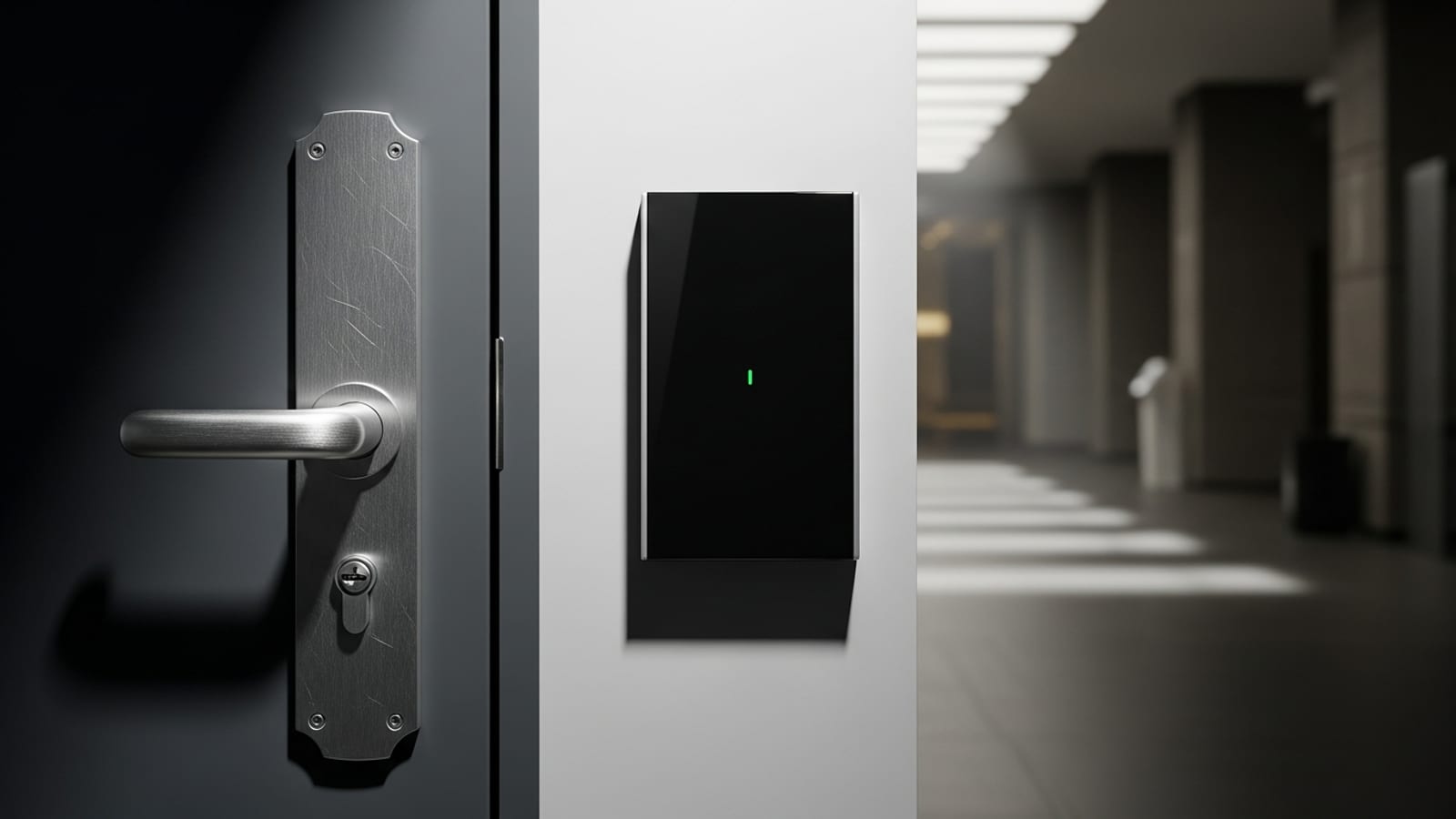
Quick answer: A Fort Worth commercial lock-and-key project breaks down into three layers: mechanical (master key system on Schlage Everest, Medeco, or Mul-T-Lock keyways) at $850-$5,000 for a typical 10-cylinder install; access control (HID readers, electric strikes, cloud platforms like Brivo or Kisi) at $1,400-$3,500 per door; and life-safety hardware (Von Duprin and Sargent panic devices) at $475-$1,800 per opening installed. ANSI/BHMA grading, IBC Section 1010 egress, and Fort Worth Fire Code adoption all govern the spec — picking the wrong tier means failing your CO inspection.
What does a master key system actually solve for a Fort Worth business?
A master key system gives one person — typically the owner or the operations manager — a single key that opens every interior lock, while everyone else has a change key that opens only the doors they need. For a Fort Worth professional services firm with twelve interior offices, a server room, and an executive suite, that means one Schlage Everest C123 key in the owner's pocket replaces twelve separate keys, and the IT consultant only gets the key that opens the server room.
The technical foundation is the ANSI/BHMA A156.5 standard, which defines how the pinning is laid out so the master and the change keys both work without cross-keying — the failure mode where a stray combination accidentally opens a door it should not. Cross-keying is the reason serious master systems require a published bitting schedule and a locksmith who has actually done the math on the cylinder count and pin depth limits.
For 10 cylinders, that math is straightforward. At 50 cylinders, the locksmith should be using charting software (Instakey, ProMaster, or Medeco's KeyMark planner) to avoid errors. Above 200 cylinders, the project graduates from master to grand-master and the keyway often switches from stock Schlage to restricted (Medeco BiLevel, Mul-T-Lock MT5+, Abloy Protec2) because the risk of an unauthorized Home Depot duplication breaks the system.
Fort Worth commercial locksmith pricing breakdown (2026)
| Project type | Per-door / per-cylinder | Typical 10-unit project | Notes |
|---|---|---|---|
| Master key — Schlage Everest standard keyway | $25-$45 cylinder, $400 labor base | $850-$1,400 | Stock keyway, copies at Home Depot allowed |
| Master key — Medeco BiLevel restricted | $95-$150 cylinder, $600 labor base | $2,200-$3,800 | No unauthorized duplication; signed cards |
| Master key — Mul-T-Lock MT5+ high-security | $120-$190 cylinder, $700 labor base | $2,800-$5,000 | UL 437 listed, top-tier pick resistance |
| Access control — standalone keypad | $850-$1,400 per door installed | — | Schlage CO-100, Yale nexTouch, no network |
| Access control — single-door cloud (Brivo/Kisi) | $1,800-$3,500 per door + $15-$45/mo | — | HID reader, electric strike, REX, cloud |
| Access control — multi-door cloud (5+ doors) | $1,400-$2,200 per door + $15-$45/mo | — | Pricing drops with door count |
| Panic bar — Detex Advantex W70 rim | $475-$725 installed | — | Non-fire-rated, single door |
| Panic bar — Von Duprin 99 with lever trim | $1,200-$1,800 installed | — | Most common spec for Fort Worth office |
| Panic bar — fire-rated UL 10C | add $200-$400 | — | Required on labeled fire doors |
When should I use restricted versus stock keyways?
Stock keyways — Schlage C, Kwikset KW1, Yale Y1 — are cheap and freely duplicated. Walk into any Home Depot, Lowe's, or Ace Hardware on Camp Bowie or in Alliance Town Center and they will copy them in 30 seconds for $3. That is fine for a small business where the master key never leaves the owner's house.
Restricted keyways — Schlage Everest 29-S, Medeco BiLevel, Mul-T-Lock MT5+, Abloy Protec2 — require either factory-only duplication or a signed authorization card on file at the issuing locksmith. The blanks are simply not sold to retail key cutters. For any system protecting cash, regulated drugs, healthcare records (HIPAA), payment card data (PCI), or HR personnel files, the cost delta is the right business decision.
Pricing-wise, a restricted Medeco cylinder runs about 3-4x what a Schlage Everest stock cylinder costs, and a Mul-T-Lock MT5+ is closer to 5x. On a 20-door office buildout, that turns a $1,800 master key project into a $5,500-$7,500 restricted-keyway project. The math becomes obvious the first time an ex-employee's copied key has to be re-pinned out of the entire system — restricted keyways make that re-pinning unnecessary because the ex-employee never had the means to duplicate in the first place.
Should I use cloud access control or a wired panel?
Cloud access control — Brivo, Kisi, Openpath (Avigilon Alta), Verkada — is the right answer for almost every Fort Worth small business under 30 doors. The hardware-per-door cost is similar to a wired Mercury or Lenel panel install, but there is no on-site server, no dedicated panel cabinet in the IT closet, and no separately-priced software contract. The platforms charge $15-$45 per door per month and include mobile credentials, audit logs, and remote unlock from a browser.
Wired panels — Mercury MR52, Honeywell ProWatch, Lenel OnGuard, Software House CCURE — are the right answer above 50 doors, in multi-tenant office buildings, or where compliance requires on-premises log retention (some HIPAA environments, all PCI Level 1 environments, federal facilities). The hardware investment is heavier upfront ($2,500-$4,500 per door installed) but there is no recurring per-door cloud fee. Operating cost crosses over at roughly 4-7 years depending on door count.
For a Fort Worth office between 5 and 30 doors — the modal case for a Cultural District professional firm, a TCU-area medical practice, or a West 7th coworking space — cloud is the obvious choice. For a multi-tenant high-rise like a downtown Sundance Square tower, the property manager almost always has a wired enterprise platform and tenants integrate into it.
What does Fort Worth Fire Code require for panic hardware?
Fort Worth has adopted the 2021 International Building Code and the 2021 International Fire Code, with local amendments published by the City of Fort Worth Development Services Department. IBC Section 1010.1.10 governs egress doors. The short version: assembly occupancies (Group A) and educational occupancies (Group E) with 50 or more occupants require panic hardware on egress doors. Business (Group B), factory (Group F), and mercantile (Group M) occupancies require it at 100 or more occupants.
For Fort Worth office buildings of the size most small-to-mid businesses lease — 4,000-25,000 square feet, occupancy load 25-150 — panic hardware is required on the primary egress doors anytime you cross the 100-occupant threshold. The Fire Marshal's office inspects this during your Certificate of Occupancy review and again during annual re-inspections.
The standard spec for a Fort Worth office build is a Von Duprin 99 series rim device or a Sargent 80 Series, both with lever trim that allows keyed entry from outside while permitting free egress with a 5-pound push from inside. Add UL 10C fire-rated dogging hardware if the door is part of a fire-rated assembly (most stairwell exits, separation between occupancies). Skipping the UL listing because it is cheaper is the most common reason inspections fail.
How do I phase a commercial buildout to control cost?
Most Fort Worth tenant improvements are phased in three waves. Wave one is mechanical: the master key system gets installed first because the GC needs key control while finishing work continues. Wave two is access control: readers, electric strikes, and panel mounting happen after low-voltage cabling but before final ceiling tile. Wave three is life-safety hardware: panic devices, mag locks, REX sensors, monitored exits — installed last and tested with the Fire Marshal present.
If budget is tight, the safe order to defer is: cloud access control upgrades from $1,800 to $3,500 per door, and decorative hardware upgrades. Do not defer: panic hardware on required egress doors (fails CO), fire-rated dogging (fails fire inspection), or strike reinforcement on exterior doors (fails insurance underwriting on a break-in claim).
- Wave 1 (week 1-2): mechanical master key system, exterior deadbolts, key cabinet
- Wave 2 (week 3-4): access control panels, readers, electric strikes, REX sensors
- Wave 3 (week 5+): panic hardware, monitored exits, fire-rated assemblies, final Fire Marshal walk
"A high-security cylinder is not about keeping a locksmith out — it is about keeping someone with a YouTube tutorial and a $30 pick set out. That is who attacks 99 percent of residences. Spend the extra $80 once and stop thinking about it."
— Clyde Roberson, Director of Technical Services, Medeco Security Locks
Sourced stats
- ANSI/BHMA A156.5 (master keying) and A156.36 (auxiliary deadlocks) are the published industry standards that define how master key systems are pinned and how deadbolts are graded for cycle count and forced-entry resistance. — Builders Hardware Manufacturers Association (2024)
- International Building Code Section 1010.1.10, adopted by the City of Fort Worth, requires panic hardware on egress doors for Group A (assembly), E (educational), and H (high-hazard) occupancies with 50+ occupants — and Group B (business), F (factory), M (mercantile) at 100+ occupants. — International Code Council (2021)
- Underwriters Laboratories publishes UL 437 (key locks resistant to attack) and UL 10C (positive-pressure fire test for door assemblies) — the two product-listing tests that determine which hardware can legally be installed in a Fort Worth high-security or fire-rated opening. — Underwriters Laboratories (2024)
- The Small Business Administration Office of Advocacy reports that small businesses with under 100 employees account for the majority of new commercial leases — the segment most likely to need a cloud-managed access control platform rather than a wired enterprise panel. — U.S. Small Business Administration (2024)
Related services
- Master key system installation
- Access control installation
- Panic bar installation
- Commercial lockout
Frequently asked questions
Do I need a separate access control vendor or can a locksmith do it all?
A full-service Fort Worth locksmith handles all three layers: mechanical (master key), access control (HID, Brivo, Kisi), and life-safety (Von Duprin, Sargent). For a system over 50 doors in a multi-tenant building, you may want a dedicated integrator who specializes in enterprise platforms like Lenel or Software House CCURE. For everything under that, one locksmith vendor is faster, cheaper, and easier to hold accountable.
How much does it cost to add a new employee to access control?
Cloud platforms (Brivo, Kisi, Openpath) charge per user per month — typically $1-$3 per user. Provisioning a mobile credential or printing an HID card takes 5 minutes from your admin portal. Removing an ex-employee is instantaneous. That zero-cost-to-rekey property is the single biggest reason access control beats mechanical keys for any company with turnover.
What happens if my master key gets lost?
Worst case for a stock-keyway system: you re-pin every cylinder in the building (4-8 hours of locksmith labor for a typical office) and reissue new keys to everyone. Cost: $800-$2,400 depending on cylinder count. Worst case for a restricted-keyway system: same re-pinning labor, but the unauthorized duplication risk is zero because no one outside your locksmith could have copied the lost key. That eliminated risk is why restricted keyways pay for themselves the first time a master goes missing.
Will you handle the Fire Marshal inspection?
We coordinate the inspection appointment, supply the UL 10C product data sheets, and we are on site for the walk-through. You should be there too — Fort Worth Fire Marshal inspections happen during business hours and require the building tenant or owner present. We have the documentation chain on hand to satisfy any question about hardware rating, installation per-spec, and post-install testing.
Sources cited
- Builders Hardware Manufacturers Association — BHMA ANSI/BHMA A156.5, A156.36 standards (2024)
- Associated Locksmiths of America — ALOA Security Professionals Association (2024)
- International Code Council — International Building Code, Section 1010 Egress Doors (2021)
- City of Fort Worth Fire Department — Fort Worth Fire Department — Fire Code Inspections (2024)
- U.S. Small Business Administration — SBA — Office of Advocacy on Small Business (2024)
- Underwriters Laboratories — UL 437 / UL 10C product certifications (2024)