Smart Lock Installation in Fort Worth: Yale vs Schlage vs August (2026 Deadbolt Comparison)
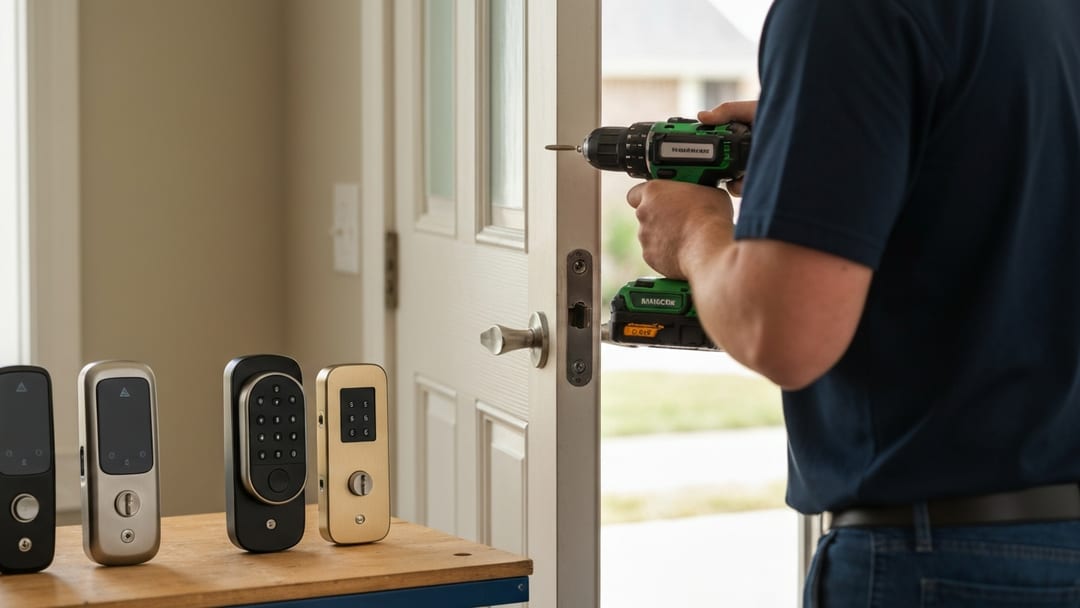
Quick answer: For a Fort Worth home in 2026, four smart locks lead the market: Schlage Encode Plus (best for Apple Home + Matter buyers, $300-$350), Yale Assure 2 Touch with WiFi ($250-$320, easiest to install on existing deadbolt prep), August Wi-Fi 4th Gen ($230-$280, the only major brand that keeps the existing deadbolt and adds a smart drive to the inside), and Level Lock Plus ($350-$400, invisible install that looks like a regular deadbolt). Choose Matter-compatible if you split between Apple Home, Google Home, and Alexa; choose Z-Wave if you already own a SmartThings or Hubitat hub; choose WiFi-only if you want zero hubs and accept 3-4 month battery life.
What actually changed in smart locks for Fort Worth homes in 2026?
Three things. First, Matter 1.2 finally made cross-ecosystem smart locks practical — the Yale Assure 2 Matter SKU, Schlage Encode Plus, and Level Lock Plus all work natively with Apple Home, Google Home, Alexa, and SmartThings without separate apps. Second, Apple Home Key — the NFC tap-with-iPhone unlock that started on Schlage Encode Plus and Aqara U100 — has spread to Level and to the latest Yale firmware, which means a Fort Worth iPhone household can tap a phone to the lock and walk in with no app open. Third, battery life on the better units finally crossed 6 months on a single charge under real-world use, which removed the largest single complaint about WiFi-only smart locks.
What did not change: the mechanical security of any consumer smart lock is roughly equivalent to a BHMA Grade 2 mechanical deadbolt. That is fine for residential use, equivalent to what your builder installed, but not equivalent to a UL 437-listed Medeco or Mul-T-Lock high-security cylinder. If you want both convenience and serious physical security, pair a smart lock on the high-traffic front door with a UL-listed mechanical deadbolt on the secondary door.
Smart lock comparison for Fort Worth homes (2026)
| Model | Connectivity | BHMA grade | Battery life | Hardware price | Best for |
|---|---|---|---|---|---|
| Schlage Encode Plus | WiFi + Apple Home Key (NFC) + Matter | Grade 2 | 6-9 months (4× AA) | $300-$350 | Apple ecosystem households, Matter buyers |
| Yale Assure 2 Touch WiFi | WiFi + optional Z-Wave + Matter SKU | Grade 2 | 8-12 months (4× AA) | $250-$320 | Easy retrofit, broad ecosystem |
| August Wi-Fi 4th Gen | WiFi + Bluetooth | Not BHMA rated (retrofit) | 3-6 months (4× AA) | $230-$280 | Renters, keep existing deadbolt |
| Level Lock Plus | Bluetooth + Apple Home Key (NFC) | Grade 2 | 12+ months (CR2) | $350-$400 | Invisible install, design-conscious |
| Schlage Encode (original) | WiFi only | Grade 2 | 4-6 months (4× AA) | $250-$280 | Tight budget, WiFi-only ok |
| Yale Assure 2 (Z-Wave) | Z-Wave Plus, needs hub | Grade 2 | 12-18 months (4× AA) | $200-$260 | Existing SmartThings/Hubitat user |
Schlage Encode Plus vs Yale Assure 2 vs August vs Level — which fits Fort Worth homes?
Schlage Encode Plus ($300-$350) is the best general-purpose choice for a Fort Worth household using Apple Home or buying Matter. Solid Grade 2 BHMA rating, built-in WiFi (no hub needed), and Apple Home Key NFC tap-to-unlock. Battery life realistically 6-9 months on 4 AA. Downside: weighs more than the original Encode and the keypad is plastic.
Yale Assure 2 Touch with WiFi ($250-$320) is the best retrofit option — the lock installs cleanly on the standard 2-3/8" or 2-3/4" backset most Fort Worth homes have without any door modification. Battery life is the best of the WiFi units at 8-12 months because the Yale low-power circuitry is more efficient. The Connected By August WiFi module is built in; the Z-Wave variant is a separate SKU. The Matter SKU shipped in late 2024.
August Wi-Fi 4th Gen ($230-$280) is the only major brand that keeps your existing deadbolt and adds a smart drive to the inside thumb-turn. That makes it the obvious choice for renters who cannot modify the door, and for homeowners who already invested in a high-security mechanical cylinder (Medeco, Mul-T-Lock) and want to keep it. Downside: shorter battery life at 3-6 months because the WiFi radio runs hot.
Level Lock Plus ($350-$400) is the design-conscious choice. The entire mechanism hides inside the existing deadbolt hole — from the outside, the lock looks like a regular Baldwin or Schlage deadbolt. Apple Home Key support is excellent, battery life is the longest in this category at 12+ months on a single CR2 lithium. Downside: setup is more involved than the others and Level's app is the weakest of the four brands.
WiFi, Z-Wave, Zigbee, or Matter — which connectivity do I need?
WiFi (Schlage Encode, Yale Assure WiFi, August Wi-Fi) works out of the box with no hub but consumes more battery. Best for a Fort Worth household that does not want to think about a smart home hub.
Z-Wave (Yale Assure 2 Z-Wave, Kwikset Halo Z-Wave) requires a SmartThings, Hubitat, or Amazon Echo hub but extends battery life to 12-18 months because the radio is lower power. Best for households already invested in a smart home hub.
Zigbee (Yale Assure 2 Zigbee variant) is similar to Z-Wave — needs a hub, longer battery. Less common in the US residential market than Z-Wave.
Matter (Schlage Encode Plus, Yale Assure 2 Matter SKU, Level Lock Plus, Aqara U200) is the new universal standard. A single Matter-certified lock works with Apple Home, Google Home, Alexa, and SmartThings without separate apps. If you are buying in 2026, Matter is the future-proof choice — it eliminates the question of which ecosystem you commit to.
Will a smart lock work on my Fort Worth front door?
Almost always. Standard residential deadbolt prep in Fort Worth — both new construction in Alliance and turn-of-the-century craftsman in Park Hill or Westover Hills — uses a 2-1/8" cross-bore (cylinder hole) with a 1" edge bore (latch hole) at either 2-3/8" or 2-3/4" backset. Yale, Schlage, Kwikset, and August are all built to fit that prep.
Non-standard doors that may require additional work: full-glass entry doors (no room for the cylinder body — needs a glass-cut replacement), commercial-prep mortise doors (require a mortise smart lock like the Yale Assure Mortise variant), pre-1950 doors with non-standard bores (we measure on arrival and quote any custom prep), and storm doors (do not install a smart lock on a storm door — the temperature swing kills the electronics).
If you have any doubt about your door, we measure for free during the installation appointment and tell you immediately if your door cannot accept a particular model before we drill or modify anything.
How much does smart lock installation cost in Fort Worth?
If you supply the lock, labor-only install runs $85-$150 per door. That includes removing the old deadbolt, installing the smart lock to BHMA torque spec, pairing the lock to your WiFi or hub, configuring the app, programming user codes, and walking you through the controls. Most Fort Worth installs take 30-50 minutes per door including setup time.
If we supply the lock and install it, total cost is $250-$500 depending on the model. Schlage Encode original $250, Yale Assure 2 WiFi $300, Schlage Encode Plus $320, Level Lock Plus $475. We do not upsell — if you want the cheaper model and it fits your use case, that is what we install.
Two doors at once costs less than two single-door visits. Three or more locks typically gets a 10-15% bundle discount on labor. Common Fort Worth scenarios: front and back door of a single-family home; front, back, and garage entry for a new build; multiple rental units for property managers.
"The single biggest determinant of whether a residential door holds up to a forced entry attack is not the lock — it is the strike plate and the screws. Three-inch screws into the framing stud, every time. That is the whole story."
— Lloyd Seliber, Master Locksmith and Schlage residential consultant (former)
Sourced stats
- Consumer Reports' Smart Lock Buying Guide identifies battery life, Wi-Fi reliability, and app stability as the three highest-weight reliability factors in its testing — and notes that WiFi-only smart locks consistently run through batteries every 3-6 months while Z-Wave and Zigbee variants last 12-18 months. — Consumer Reports (2024)
- The Connectivity Standards Alliance launched Matter 1.0 in late 2022 and Matter 1.2 in 2023 as the cross-ecosystem standard letting a single smart lock work natively with Apple Home, Google Home, Alexa, and SmartThings without separate apps or hubs. — Connectivity Standards Alliance (2024)
- ANSI/BHMA A156.36 grades residential deadbolts (Grade 1, Grade 2, Grade 3) based on cycle count and forced-entry resistance — and most consumer-grade smart locks (August, Schlage Encode, Yale Assure) carry a BHMA Grade 2 rating, equivalent to a residential heavy-duty mechanical deadbolt. — Builders Hardware Manufacturers Association (2024)
- Underwriters Laboratories publishes UL 437 (high-security key locks) for cylinders that resist physical attack — and most consumer smart locks are not UL 437 listed, which is one reason serious security-conscious homeowners pair a smart lock for convenience with a UL-listed mechanical Grade 1 deadbolt on the secondary door. — Underwriters Laboratories (2024)
Related services
Frequently asked questions
Can a smart lock be hacked?
The cylinder itself is roughly equivalent to a BHMA Grade 2 mechanical deadbolt — same physical security. The "hacking" risk is the WiFi/Bluetooth connection, but a real-world break-in via smart-lock network attack is so rare it is essentially theoretical. Burglars in the Fort Worth area overwhelmingly use brick-through-window or kick-the-door techniques. The strike plate and 3" framing screws are the security investment that matters, not the lock electronics.
What happens if the WiFi or hub goes down?
You unlock the door with the physical key (always included with Schlage, Yale, Kwikset) or with the keypad code stored locally on the lock. None of the four major smart locks lose function during a WiFi outage — they only lose remote-unlock and notifications. The deadbolt continues to operate via key, keypad, and Bluetooth proximity.
Will my smart lock work in extreme Fort Worth summer heat?
Yes. All four major brands list operating temperatures from roughly -22°F to +150°F. Direct-sun exposure on a south-facing door in Fort Worth July (130°F surface temp) is within spec. The one thing to watch is battery life — extreme heat accelerates battery drain by 30-50% versus moderate temps.
How long does smart lock installation take?
Per door, 30-50 minutes from start to walking-you-through-the-app. Two doors at a single home, 60-90 minutes total. The biggest variable is the WiFi pairing — older or weaker home WiFi networks sometimes require a network extender near the door to keep the lock connected, and we will tell you on site if that is needed.
Sources cited
- Consumer Reports — Smart Lock Buying Guide (2024)
- Connectivity Standards Alliance — Matter specification (2024)
- Builders Hardware Manufacturers Association — BHMA ANSI/BHMA A156.5, A156.36 standards (2024)
- Associated Locksmiths of America — ALOA Security Professionals Association (2024)
- Underwriters Laboratories — UL 437 / UL 10C product certifications (2024)